







 Society
55505510
Verschwörungstheorien
Durch interaktive Aufgabentypen wird das audiovisuelle und interaktive Lernen einfach.
Lernen macht jetzt Spaß!
Included Tasks
- 1. Verschwörungstheorien - Definition und Begrifflichkeit (15 Minuten)
- 2. Die Anfänge der Verschwörungstheorien (10 Minuten)
- 3. Die Geschichte von Verschwörungstheorien - Zuordnungsaufgabe (10 Minuten)
- 4. Gründe für Verschwörungstheorien - Zuordnungsaufgabe (5 Minuten)
- 5. Warum sind Verschwörungstheorien gefährlich? (15 Minuten)
- 6. Verschwörungstheorie oder Fake News? - Zuordnungsaufgabe (5 Minuten)
- 7. Medien - Definition und Unterteilung (10 Minuten)
- 8. Die Funktionen von Medien (15 Minuten)
- 9. Erkennen von Fake News (10 Minuten)
- 10. Fake-News erkennen - Zuordnungsaufgabe (10 Minuten)
- 11. Informationen richtig recherchieren (15 Minuten)
- 12. Fakten checken (10 Minuten)
- 13. Wie geht ein Faktencheck? (10 Minuten)
- 14. Quellenbewertung - Zuordnungsaufgabe (5 Minuten)
- 15. Maßnahmen gegen Verschwörungstheorien (5 Minuten)
- 16. Diskrete Einflussnahme - Interaktives Video (5 Minuten)
- 17. Einfluss des Internets - Interaktives Video (5 Minuten)
- 18. Veränderte Öffentlichkeit - Interaktives Video (5 Minuten)
- 19. Regulierungsbedarf - Interaktives Video (5 Minuten)
- 20. Grenzen der Meinungsfreiheit - Interaktives Video (5 Minuten)
- 21. Antisemitismus in Verschwörungstheorien - interaktives Buch (15 Minuten)
- 22. Die skurrilsten Verschwörungstheorien - Bildkarten (5 Minuten)
- 23. In welchem Jahr wurde welche Verschwörungstheorie verbreitet? (5 Minuten)
- 24. Wo entstand welche Verschwörungstheorie? (10 Minuten)
- 25. Troll-Armeen - Definition und Vorgehensweise (15 Minuten)
- 26. Der goldene Aluhut - Zuordnungsaufgabe (10 Minuten)
- 27. Die Verschwörungstheorie zu 9/11 (15 Minuten)
- 28. Der Absturz der Hindenburg - Lückentext (5 Minuten)
- 29. Die Illuminati (15 Minuten)
- 30. Waren die Menschen auf dem Mond? - Lückentext (10 Minuten)
- 31. Flat Earth Theory - Lückentext (10 Minuten)
- 32. Klimawandel-Leugnung - interaktive Aufgaben (15 Minuten)
- 33. Inszenierte Mondlandung- interaktives Buch (15 Minuten)
- 34. Verschwörungstheorien zu Corona - Wortsuchrätsel (5 Minuten)
- 35. 5G Verschwörungstheorien - Zuordnungsaufgabe (5 Minuten)
- 36. Das Kennedy-Attentat (15 Minuten)
- 37. Chemtrails - Markiere die Wörter (5 Minuten)
- 38. Die neue Weltordnung - Zuordnungsaufgabe (10 Minuten)
- 39. Hoax - Lückentext (5 Minuten)
- 40. Paul McCartney is dead - Lückentext (5 Minuten)
- 41. Reptiloidenthorie - Lückentext (5 Minuten)
- 42. Big Lie (Amerikanische Wahlen 2020) - Lückentext (5 Minuten)
- 43. Verschwörungstheorien um Bill Gates (15 Minuten)
- 44. Area 51- Zuordnungsaufgabe (5 Minuten)
- 45. Area 51 - Kreuzworträtsel (5 Minuten)
- 46. Dolchstoßlegende - Lückentext (10 Minuten)
- 47. Dolchstoßlegende - Kreuzworträtsel (10 Minuten)
- 48. Reichsbürgerbewegung - Zuordnungsaufgabe (5 Minuten)
- 49. Reichsbürgerbewegung - Kreuzworträtsel (10 Minuten)
- 50. Elvis Presley - Zuordnungsaufgabe (5 Minuten)
Curriculum-centred and oriented towards educational standards
Matching


Mobile Learning II
Oh, what’s that? Original soundtrack Thissen: “As our children grow up in a media world and naturally handle the media, they should also be a topic in school.“ An older child says the point is that they don’t just load down apps but create things themselves that haven’t existed so far. Hi, I’m Jana. A propeller hat. I’ll put it on. Now I’m no longer a simple rhino, but a flying rhino. Original soundtrack Thissen: “It’s exactly the great flexibility of tablets that promotes very personalised and adapted learning.” Original soundtrack Welzel: “It’s fascinating to see how the children grow with their products and how they always want to improve them.” The Westminster Abbey is a church in London for the royal family. Original soundtrack Welzel: “And?“ They think it is ok.

Racism
Do you perhaps know that?

Internet Addiction
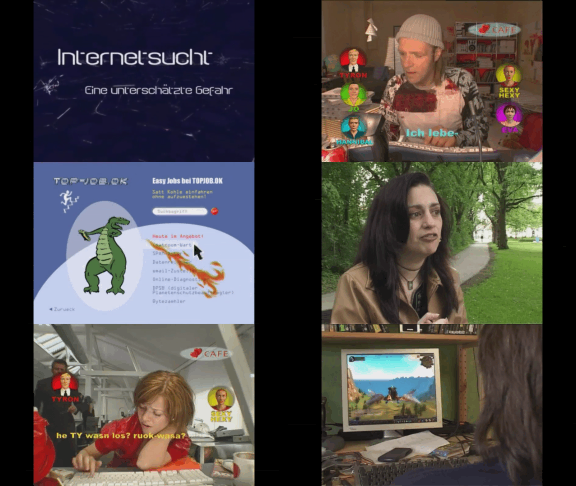
The film consists of two parts. The first part is the 15-minute short film “In the Net”. It describes the problem of excessive Internet use in a humorous way, in particular the risk of losing touch with reality when chatting. The second part illustrates with three real persons how Internet addiction can develop and the problems encountered by those who are afflicted. The authentic statements are commented by an experienced therapist. For many pupils, the issues addressed here are related to their everyday lives. What is a “sensible” use of the Internet, where does pathological addiction start? In contrast to addiction to alcohol, nicotine or drugs, the public seems to be largely ignorant of the problem of this addiction, which is not related to any substance abuse. The film provides material for discussion in the classroom (crossdisciplinary) and can be used as a basis for the formulation of prevention strategies.