







 Preschool, Primary School

4679022 / 5565783
Saint Martin
Sharing and Why We Celebrate It
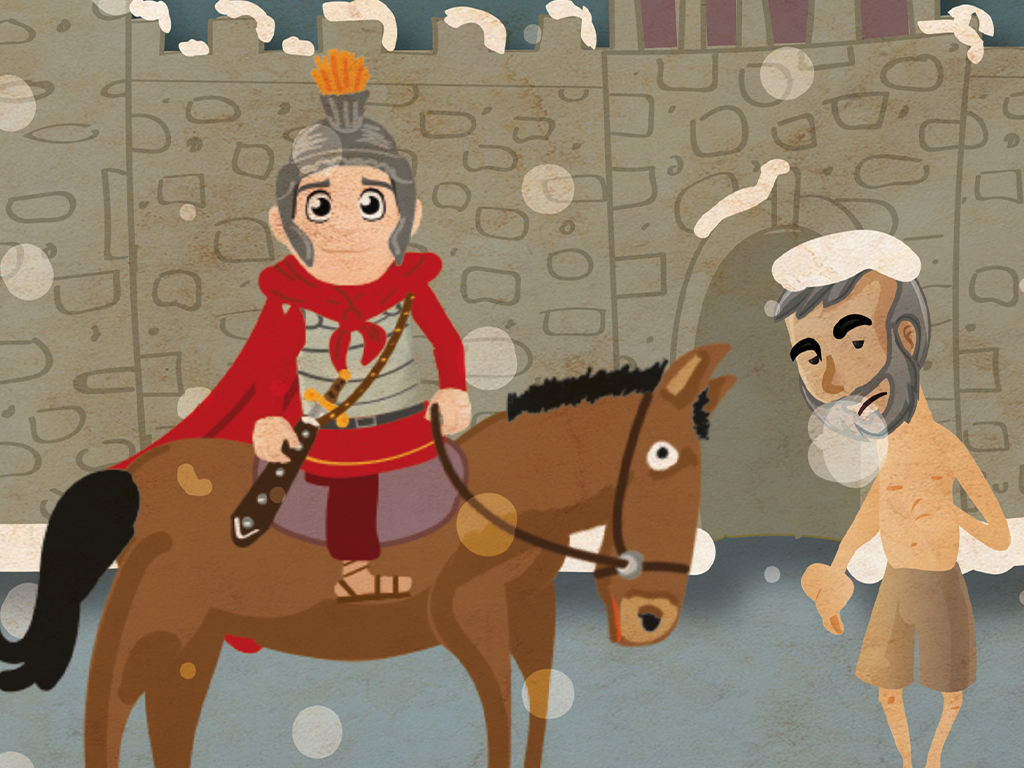
Every year on November 11, Saint Martin’s Day is celebrated. This church festival is also referred to as Saint Martin’s Feast. Depending on the community or region where you live, there are different rites connected to this festival. Among them are St. Martin’s songs, St. Martin’s processions and in some families, a goose is served as a feast – the so-called St. Martin’s Goose. But who was this Martin and why is he called Saint Martin or, more precisely, why is he a saint? On this picture from the Middle Ages, Saint Martin is once depicted as a young soldier and once, on the right, as the bishop of the city of Tours, which he was ordained later as an older man.
Play trailer
- <> Languages: DE, EN
- <> Target Groups: ELE, GRU
- <> Subject: Preschool, Primary School
- <> Length: 22:30 min
- View in learning platform
Licenses
Curriculum-centred and oriented towards educational standards
Matching


Mobile Learning II
Oh, what’s that? Original soundtrack Thissen: “As our children grow up in a media world and naturally handle the media, they should also be a topic in school.“ An older child says the point is that they don’t just load down apps but create things themselves that haven’t existed so far. Hi, I’m Jana. A propeller hat. I’ll put it on. Now I’m no longer a simple rhino, but a flying rhino. Original soundtrack Thissen: “It’s exactly the great flexibility of tablets that promotes very personalised and adapted learning.” Original soundtrack Welzel: “It’s fascinating to see how the children grow with their products and how they always want to improve them.” The Westminster Abbey is a church in London for the royal family. Original soundtrack Welzel: “And?“ They think it is ok.


Seal of approval
Quality seals such as the "Bio-Siegel", "Blauer Engel", "Stiftung Warentest" and up to 1,000 other seals represent characteristics such as sustainability, health or safety with regard to a product, a service or even a company.


Rights and Obligations
Three girls of different ages: Anna is 17, Paula 15 and Lena 13. Before the law, their respective ages have consequences – because children and adolescents have different rights and also obligations.