







55502536
Grundlagen chemisches Rechnen 1
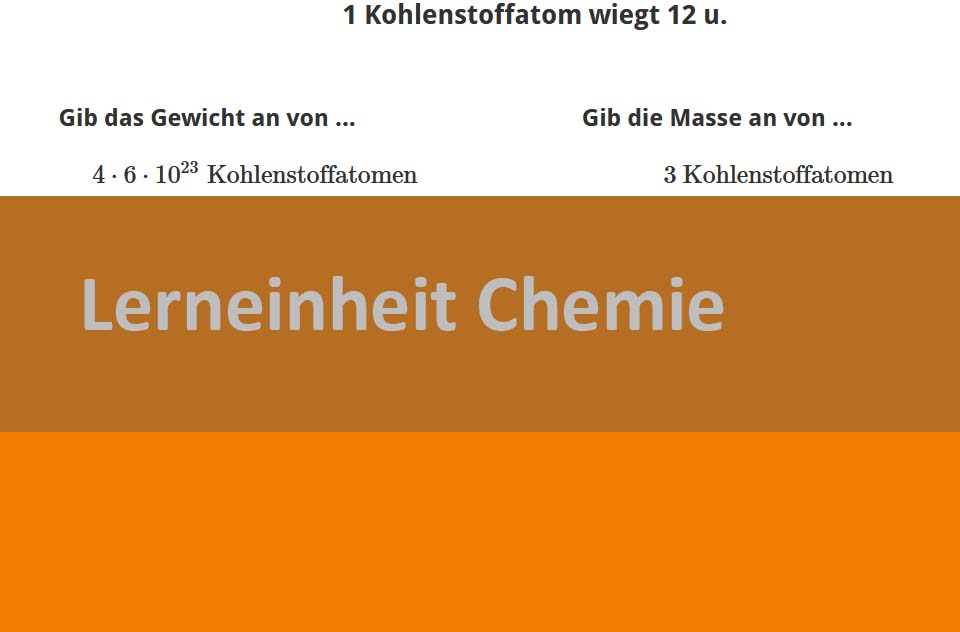
In 10 interaktiven H5P-Modulen gibt es Aufgaben zu Berechnungen von Masse, molarer Masse und Stoffmenge.
Das Medium bietet H5P-Aufgaben an, die ohne zusätzliche Software verwendbar sind.
Durch interaktive Aufgabentypen wird das audiovisuelle und interaktive Lernen einfach.
Lernen macht jetzt Spaß!
Included Tasks
- I Formeln; Größen und chemisches Rechnen - Wissensvermittlung
- II Berechnungen mit Unit (u) und Mol (mol) - (1)
- III Berechnungen mit Unit (u) und Mol (mol) - (2)
- IV Berechnungen mit Unit (u) und Mol (mol) - (3)
- V Finde die 7 Elemente - die nie als einzelnes Atom vorliegen
- VI Berechnungen der molaren Masse einer chemischen Verbindung (1)
- VII Berechnungen der molaren Masse einer chemischen Verbindung (2)
- VIII Berechnungen von molarer Masse mit verschiedenen Vorgaben (1)
- IX Berechnungen von molarer Masse mit verschiedenen Vorgaben (2)
- X Gemischte Berechnungen Masse; Stoffmenge; molare Masse
Curriculum-centred and oriented towards educational standards
Matching
Basics of Chemistry II
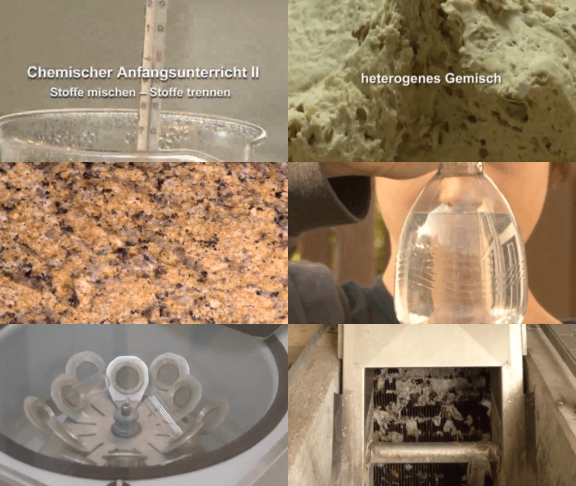
When we take a closer look at substances, we discover that they consist of either one single element or of mixtures of several elements. Chemists therefore divide the world of substances into pure and mixed chemical substances. A pure substance is of homogeneous composition. Substance mixtures, however, consist of two or more pure substances. The many mixtures are subdivided not only into homogeneous and heterogeneous mixtures but depending on the respective aggregate states of their components, are classified into various groups of mixtures.

Acids and Bases
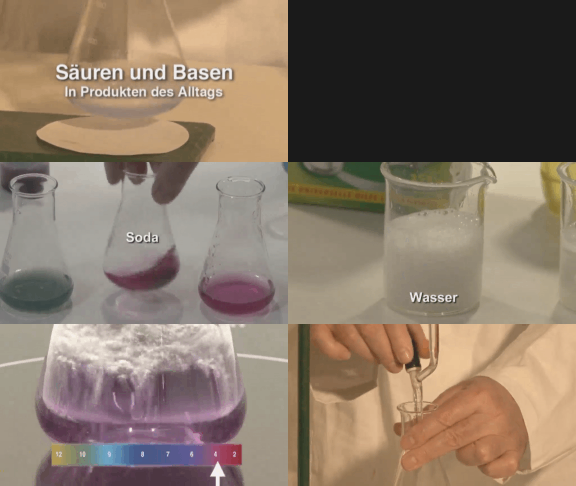
We can find acids and bases in every supermarket, some of them in our food, others in cleaning agents. In everyday products, acids and bases as well as acidic and alkaline reacting salts have extremely different functions. In food, acids are either present or added as flavouring agents such as citric acid, tartaric acid and acetic acid, as antioxidants such as ascorbic acid or generally as acidifiers, sequestrants (citric acid and tartaric acid) and preservatives (acetic acid).

Halogens
The compounds of halogens are - with the exception of astatine - widespread, can be encountered in nature and are versatile substances. This fact is taken up on this DVD in order to teach the students the chemistry of the halogens by illustrating their special qualities and explaining the correlation of their structure with their chemical properties. In the first part, an overview of the element group of halogens lays emphasis on the common as well as on the distinguishing characteristics of fluorine, chlorine, bromine and iodine. In a second part, the specific properties of fluorine and chlorine are presented. This topic is linked to the students‘ everyday experience (fluorine as a protection against caries, chlorine as a disinfectant, etc.) on the one hand. On the other hand, the DVD presents carefully selected experiments. As a rule, they are of a kind that can only be realized with difficulty, or high expenditure in the chemistry classroom. With the help of these experiments, students are introduced to the chemistry of the halogens in a way that enables them to draw conclusions on the basis of their observations.