







 Geography

4657332 / 5551523
New York City
1967 and 2007
A global metropolis of superlatives: the world capital of trade and culture is bustling with 8.1 million people from all nations. Due to its sea port, New York City became increasingly significant in the 19th century, before proceeding to transform into a unique megacity. Formed by immigration and commodity trade, the city today is above all known for its stock exchange, culture, the UN headquarters and its tourist attractions. This didactic DVD offers a clearly structured overview of the city on the east coast of the United States. In the first four chapters, maps and impressive pictures give an overview of the geographical situation of the city, its history and politics as well as education, language and traffic in the metropolis. Important sights and an insight into the lives of its inhabitants can be found in the last chapter. As a special feature, we offer a film from 1967 on New York City. Both films are excellently suited for comparison, on the one hand with respect to the city’s historical development and on the other hand with respect to the presentation on film.
Play trailer
Curriculum-centred and oriented towards educational standards
Matching

Part Time Kings
Your children are not your children

Product Piracy
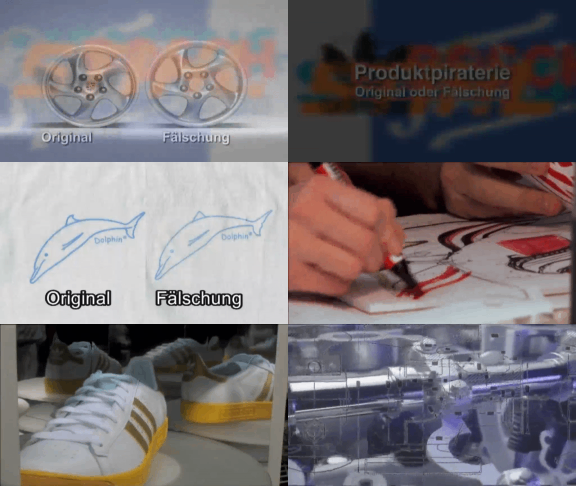
Counterfeiting takes place in almost all economic sectors – textiles, watches, car parts, machine parts, tools, accessories, software and medicines. Some counterfeits are easy to recognise, others are so well-executed that even experts have difficulty distinguishing between original and imitation. This DVD covers the development of a product from idea to manufacture. Once a product has become a trademark, product pirates appear on the scene.


Internet Addiction
The film consists of two parts. The first part is the 15-minute short film “In the Net”. It describes the problem of excessive Internet use in a humorous way, in particular the risk of losing touch with reality when chatting. The second part illustrates with three real persons how Internet addiction can develop and the problems encountered by those who are afflicted. The authentic statements are commented by an experienced therapist. For many pupils, the issues addressed here are related to their everyday lives. What is a “sensible” use of the Internet, where does pathological addiction start? In contrast to addiction to alcohol, nicotine or drugs, the public seems to be largely ignorant of the problem of this addiction, which is not related to any substance abuse. The film provides material for discussion in the classroom (crossdisciplinary) and can be used as a basis for the formulation of prevention strategies.